 KEYFACT Energy
Eco Wave Power Global, a leading onshore wave energy technology company, has submitted the final project completion report to Shell International Exploration and Production, marking the successful completion of the wave energy pilot objectives under a Pilot Test Agreement entered between the parties in 2024.
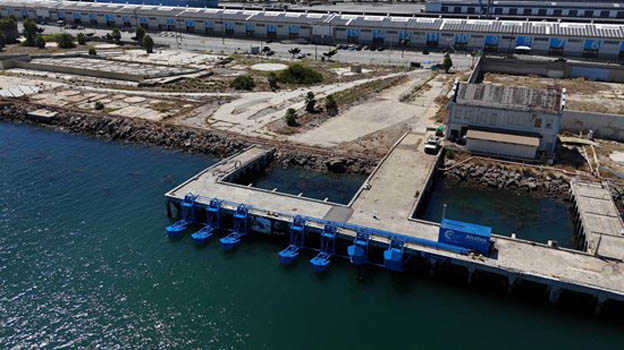
Eco Wave Power pilot in LA, by Erik Olsen
The submission of the final report represents the completion of all contractual milestones and deliverables under the Pilot Test Agreement signed in 2024 between Eco Wave Power and Shell, concluding a structured development program that progressed from feasibility analysis through engineering design, system installation, operational testing, and final reporting.
Strategic Collaboration and Project Background
The collaboration between Eco Wave Power and Shell began with a comprehensive feasibility study of the U.S. coastline, aimed at assessing the technical and commercial potential of deploying wave energy systems along U.S. coastal infrastructure. The study identified 77 sites with favorable conditions for potential wave energy projects, providing a strategic and technical foundation for advancing to a physical pilot installation in the United States.
Building on the findings of the feasibility study, Eco Wave Power and Shell entered into a Pilot Test Agreement in 2024 for the development, installation, testing and reporting of an onshore wave energy pilot project at AltaSea in the Port of Los Angeles.
The agreement was structured as a phased, milestone-based program, under which funding tranches were released upon successful completion of predefined deliverables. These deliverables covered the full lifecycle of the project - from site approvals and engineering design through manufacturing, installation, operational testing and final reporting.
Project Execution and Operational Results
Eco Wave Power successfully executed all phases of the pilot program. The Company secured all required regulatory approvals and site permits, finalized the engineering design for the installation, manufactured the system's floaters and key mechanical components, and completed the full on-site installation of the wave energy system at AltaSea.
The project progressed through the entire development lifecycle, including permitting, engineering design, fabrication, installation and an operational trial period under real marine conditions.
During development and the operational trial period, the project achieved several key milestones:
Full development lifecycle completed, including permitting, engineering design, fabrication, installation and operational testing.
Successful integration with existing marine infrastructure, validating that wave energy systems can be deployed on coastal structures without seabed anchoring, offshore construction activities or subsea cabling.
Regulatory feasibility confirmed, with all required approvals obtained, including the U.S. Army Corps of Engineers Nationwide Permit (NWP 52) and the Port of Los Angeles Revocable Permit (RP25-05). Environmental reviews conducted under the National Environmental Policy Act (NEPA) and the California Environmental Quality Act (CEQA) determined that the installation would have no significant environmental impact.
Operational reliability demonstrated, with the system successfully operating under real marine conditions and tidal variations without structural degradation.
Cost and deployment advantages validated, with the total capital cost of the pilot project remaining below $1 million, demonstrating the economic advantages of Eco Wave Power's onshore configuration compared with offshore wave energy systems.
In March 2026, Eco Wave Power submitted the final project completion report to Shell under the Pilot Test Agreement, confirming that the pilot successfully achieved its technical and operational objectives and thereby completing the full scope of the agreement.
Industry Recognition
Eco Wave Power's technology was also highlighted in a report by a U.S. Department of Energy National Laboratory, which emphasized the economic and deployment advantages of coastal-structure-integrated wave energy systems. The report noted that such systems may offer reduced installation complexity and lower infrastructure requirements by leveraging existing marine structures such as breakwaters and port infrastructure.
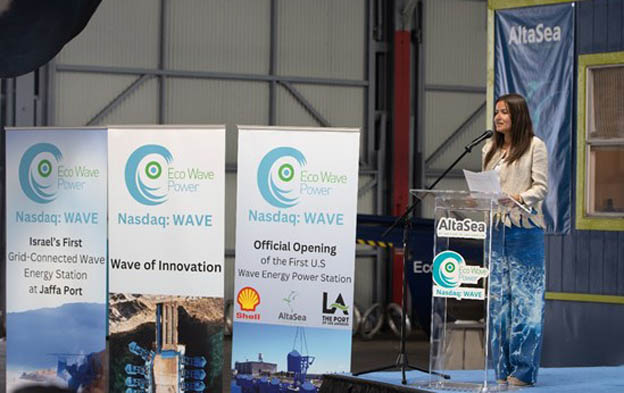
Inna Braverman, opening ceremony of LA pilot
Inna Braverman, Founder and Chief Executive Officer of Eco Wave Power, commented:
"This project followed a clear and disciplined development path — beginning with a comprehensive feasibility study of the U.S. coastline, advancing through engineering, installation and operational testing, and concluding with final delivery under the Pilot Test Agreement with Shell. Successfully completing the full scope of this program demonstrates Eco Wave Power's ability to execute complex wave energy projects together with leading global energy companies."
Supporting the Future of Coastal Renewable Energy
The Port of Los Angeles pilot serves as an important reference installation for Eco Wave Power's technology and demonstrates that wave energy systems can be deployed safely, cost-effectively and with minimal environmental impact using existing coastal infrastructure.
By eliminating the need for seabed anchoring, offshore construction and subsea cabling, Eco Wave Power's onshore technology offers a simplified deployment pathway that may accelerate the commercialization of wave energy projects globally.
The installation at AltaSea will continue to operate as an educational and demonstration facility, showcasing wave energy technology to policymakers, researchers, industry stakeholders and potential commercial partners.
Eco Wave Power believes that the successful completion of the Port of Los Angeles pilot establishes a technical and regulatory foundation for future commercial-scale wave energy deployments on breakwaters, port structures and other coastal infrastructure worldwide.
KeyFacts Energy Industry Directory: Eco Wave Power
