 KEYFACT Energy
TRACS International announces a new training course – The Application of PRMS Reserves and Resource Guidelines.
The objective of the short course is to provide those involved in the annual reserves reporting cycle with the knowledge to apply PRMS Guidelines to oil and gas assets, from exploration through to mature field opportunities.
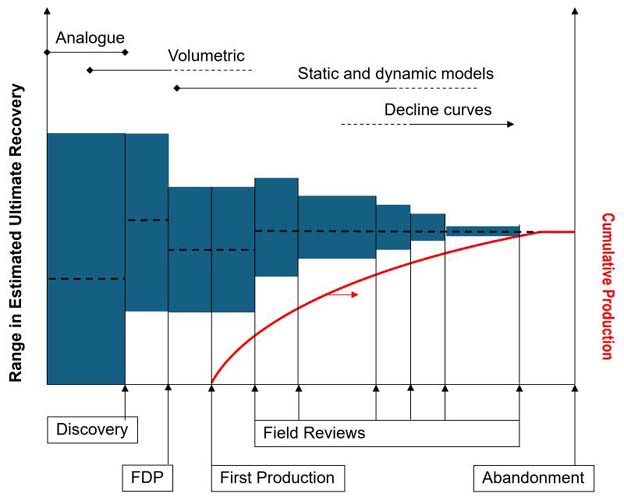
Led by Mark Cook, and designed for geoscientists, reservoir / petroleum engineers and commercial professionals, this 1.5-day course can be tailored to confidential, client-led issues, and covers:
Day 1
- PRMS documentation: Short history, documents available from SPE et al.
- PRMS Framework: Project based evaluation; Typical annual reserves reporting cycle
- Classification: Petroleum Initially In Place (PIIP) definitions; Maturity levels (PR, CR, Reserves); What constitutes discovery and commerciality (Pg, Pc): Sub-classes of PR, CR, Reserves (JD,AD, PUD,PD); Examples and quiz time
- Categorisation: Ranges of uncertainty; Probabilistic methods (P90,P50,P10); Deterministic methods (L,M,H); Forecasting methods used by subsurface team; DCA, MBAL, modelling overview
- Ambiguities, and potential pitfalls In Classification and Categorisation: Split classification – how to avoid it; Examples of contentious cases
- Range estimation: Human bias heuristics; Examples
Day 2
- Cut-offs of profiles: Cessation of Production (COP), Economic Limit (EL), Technical Limit (TL), Licence expiry. First limit principles; Examples
- Product price and cost assumptions: Internal and published price decks, gas sales agreements; Example sources (WoodMac, futures market, auditor’s view)
- Entitlement: Fuel and flare, impurities, royalty, tariffs, working
- interest (WI)
- Incremental projects & economic tests: Double dipping, impact on the base, sequencing of increments
- Portfolio resource booking; Aggregation of reserves – PRMS guidelines; Probabilistic vs arithmetic (implication of adding P90s); Corporate metrics – reserves replacement ratio (RRR) and Reserves/Production (R/P) ratio
- Treatment of hubs and tie-ins: What additions can extend hub life and how to book
- Engagement: Partners, Government, Market, Society
- Prepare for audit: Recommendations for a smooth process
Course Duration: 1.5 days
Full details l KeyFacts Energy Industry Directory: TRACS l KeyFacts Energy news: Training
