 KEYFACT Energy
By Catherine McBride OBE
I was delighted to read the Sunday Times editorial headline: ‘Spurning the North Sea’s gifts makes little sense for Britain.’ The editorial correctly claims that the Labour Party’s message on energy is confused waffle: Ed wants to block oil and gas, but Rachel (and the country) needs the jobs and revenue from them. However, the Sunday Times is just as confused. Towards the end of the editorial promoting oil and gas development, we read: ‘Nobody should doubt that our long-term future lies with renewables.’ This is the same newspaper that has a story on its front page about how a shortage of jet fuel could cause disrupt summer holiday travel.
This level of cognitive dissonance may be the Sunday Times’ editorial team hedging its bets in case Ed Miliband becomes Prime Minister in May, or perhaps they are preparing for a Green Party Prime Minister after the next election. Either Way, they should be aware that renewables only produce electricity, and sporadically at best, while over three-quarters of UK energy consumption comes from oil and gas, NOT electricity. The obvious and topical example is jet fuel.
There is really no reason why the UK’s future should lie with renewables made in China using coal when the UK has ample supplies of oil and gas. Unfortunately, people have been talking about net-zero carbon emissions for so long that they appear to have forgotten how it is measured, what emissions are not counted, and why this process is nonsense. So I thought it would be worth reviewing exactly what the UK’s reaching ‘Net Zero’ means for the Earth’s atmosphere.
1. Which emissions are counted
The United Nations Framework Convention on Climate Change (UNFCCC) requires countries to produce national greenhouse-gas inventories in accordance with the Intergovernmental Panel on Climate Change (IPCC) Guidelines. This covers the gases that must be counted, which sectors must be included, how to measure emissions and removals, and how to treat land uses, forests, peatlands, agriculture, industry, energy, and waste. All countries must submit their greenhouse gas inventory to the UNFCCC .
UNFCCC’s emissions accounting standards solely concentrate on the greenhouse gas emissions, which are considered by the UN to be ‘man-made’. So they don’t count natural emissions released from oceans, volcanoes, swamps and bogs, or wild ruminant animals. And they strangely also don’t count the most obviously ‘man-made’ source of CO2 – the 1 kilo of CO2 each person breathes out each day.
2. Territorial emissions, but not imported emissions
The UNFCCC is only interested in a country’s national territorial emissions. That means they also don’t count the emissions from imported goods, international investments, goods made in offshore factories owned by UK companies, nor international shipping and aviation that is not allocated to the UK.
This has allowed the UK to claim it has halved its CO2 emissions since 1990. In reality, successive governments have simply made UK manufacturing uncompetitive by imposing higher carbon taxes than those in other EU and Asian countries, forcing UK manufacturers to either go out of business or to move their factories offshore.
While claiming to have cut UK annual CO2 emissions by almost 300 million tonnes in 2024, the UK imported goods whose manufacture emitted about 180 million tonnes. Emissions reductions have just become a bait-and-switch strategy.
Manufacturing’s share of UK GDP has halved since 1990, from 16% to just 8%, as have UK carbon dioxide emissions, not due to a successful Green transition but to simple deindustrialisation. The speed of this decline has increased since 2019; the UK has lost an estimated 150,000 to 200,000 industrial jobs due to deindustrialisation and high energy prices, with the steepest declines in energy-intensive sectors such as steel, chemicals, ceramics, and paper.
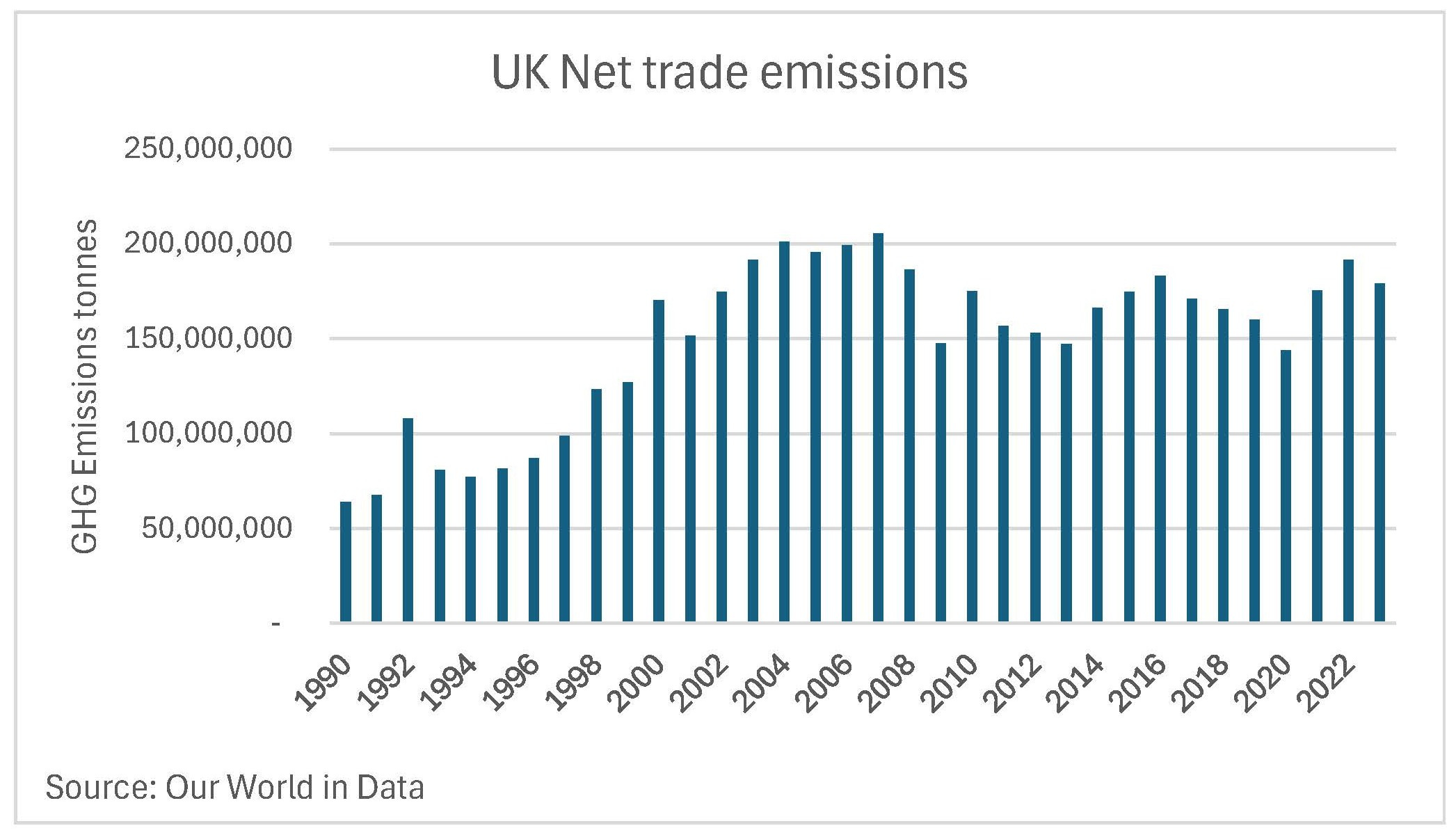
The Chart below shows the UK’s annual net trade emissions, that is, the emissions from goods imported each year by the UK minus the emissions from goods exported by the UK. The data comes from Our World in Data, which has tabulated it from Eurostat, OECD, IMF, World Bank and Global Carbon Budget data. In total, since 1990, emissions from UK net trade exceed 5 billion tonnes, but these aren’t included in the UK’s UNFCCC emissions measurements.
3. Global emissions are not dropping
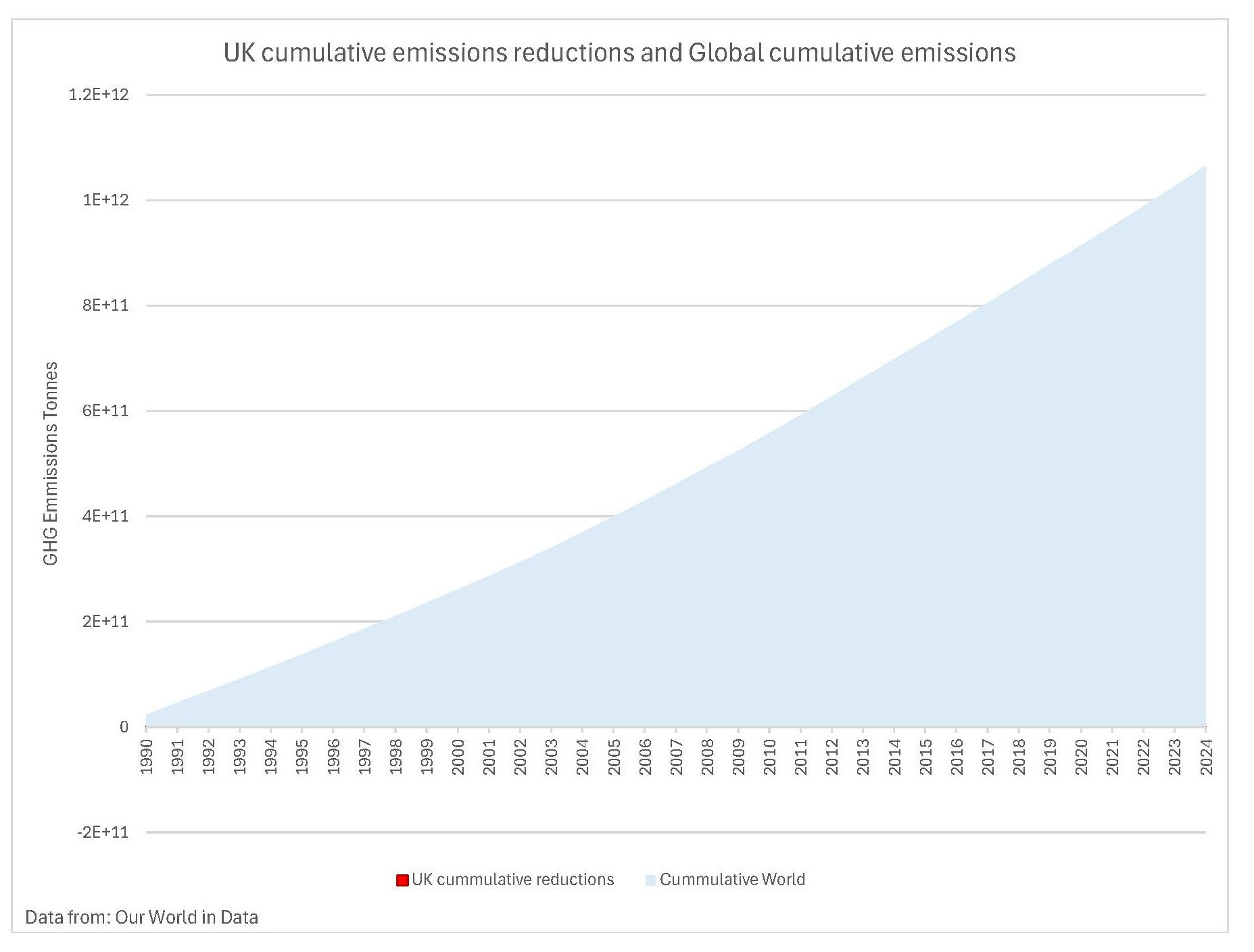
Since 1990, over a trillion tonnes of CO2 emissions have been put into the Earth’s atmosphere. Most of this has come from developing countries that are happy to supply the UK and Europe with the goods they no longer make because of their obsession with cutting their territorial emissions and reaching Net Zero. The exact cumulative Global emissions between 1990 and 2024 are 1,064,765,046,000. If the UK had not reduced its cumulative territorial emissions by 289,039,560 over the same period, global emissions would have been 1,065,054,085,560. Both numbers round to 1.065 trillion.
The chart below clearly shows that the UK’s deindustrialisation has made absolutely no difference to global emissions; the red area at the bottom of the chart shows the UK’s emission reduction – it is barely visible. And for readers unfamiliar with scientific notation: 1e12 is 1 followed by 12 zeros, i.e. 1,000,000,000,000 tonnes.
4. Both Europe and the world need more oil and gas, not less
The UK is one of about 40 nations with ample oil, gas and coal suppliers. This is a valuable resource that should be exploited for domestic use or for export. Hopefully, in resolving the current Labour Party energy confusion, Team Rachel will win the day: The UK’s economy could really use the boost that additional employment, tax revenue, and export revenue from increased oil and gas production would bring. The world could also really use additional supplies of oil, gas, and coal outside the Persian Gulf. This is especially true of the EU, which has very little domestic oil, gas, or coal, and is already our largest export market for crude oil and is connected to the UK by pipeline for gas transport. So why isn’t the UK prepared to increase its production and export its resources, even to Europe? The government wants to let the EU set UK rules, but isn’t prepared to help the EU during its energy shortages. When the commentariat states that oil and gas are sold on international markets to the highest bidder, they ought to also investigate which countries are the highest bidders.
Restricting the development of new oil fields in the vain belief that this is helping to reduce global carbon dioxide emissions benefits no one: not the potential workers extracting the coal, gas and oil, not the exchequer collecting the tax, and not the global emissions which have increased by over one trillion tons since 1990. (the reference year used by the UK in its Paris Agreement Commitments to reduce CO2 emissions.)
5. UK emissions targets have helped the developing world
The UK’s 300 million tonne annual CO2 reduction is invisible when compared to the global increase. The main result of the UK’s efforts has been to export its emissions to countries without carbon taxes and environmental restrictions on their industry. The imported goods from these countries have 180 million tonnes of associated CO2 emissions. So, the UK has only reduced its emissions by 120 million tonnes, mainly by converting coal-fired power plants to gas-fired ones. This happened in the 1990s, long before the Paris Agreement was signed in 2015, and was done for commercial reasons rather than environmental ones. Cynically, I suspect this commercially inspired emission reduction may have been why the UK wanted to measure its emissions relative to 1990 in the Paris Agreement.
The Paris Agreement is a strange agreement that allows every country to set its own emissions targets and reference date. And not all of the targets were reductions. For example, China’s Paris Agreement target was to reach peak emissions around 2030; it did not set a reduction target.
But the Paris agreement has had some positive outcomes for global trade, as developed nations such as the UK, which wanted to virtue signal their CO2 reduction credentials, helped developing nations industrialise by importing their goods. These imported goods were relatively cheaper, so consumers in developed nations also benefited, and they were “emission-free” from a UNFCCC perspective. The resulting industrial development has probably done more for the world than reducing CO2 emissions ever could have.
Of course, not everyone benefited. Many workers in developed nations lost their jobs as factories were moved to Asia, Africa, and Latin America to avoid CO2-emission taxes and penalties. The Great British Business Council’s paper, Premeditated Industrial Destruction, explores how and why the UK destroyed its industries and how to reverse this.
Original article l KeyFacts Energy: Commentary
