 KEYFACT Energy
By Gareth Rapley, Portfolio Director for Energy and Marine at RX Global, and Frank Yu, Senior Vice President at Envision Energy
For much of the past decade, the hydrogen sector has been defined by roadmaps, pilot programmes and policy commitments. That era is ending. Across the globe, momentum has shifted decisively towards execution, with industrial-scale projects moving from planning to operation and early export trade beginning to take shape. The question is no longer whether green hydrogen can be produced at scale. It is who will ensure reliable delivery, and how fast.
The World Hydrogen Summit, which returns to Rotterdam this week (19–21 May), will bring together the developers, policymakers, financiers and off-takers at the centre of this shift. One of the clearest examples of what industrial-scale deployment looks like in practice is Envision Energy, whose Chifeng net-zero industrial park is already producing and exporting green ammonia at commercial volumes.
Much of the global hydrogen debate still centres on subsidies and incentive structures, but a different model is emerging alongside it. Where the most advanced projects are achieving cost reduction, they are doing so primarily through manufacturing scale and supply-chain depth rather than price support alone.
Electrolysers, membranes, electrodes and balance-of-plant components are being produced in increasing volumes, with rapid iteration compressing both cost and development timelines. The result is not simply cheaper equipment, but a self-reinforcing supply chain capable of continuous optimisation. As production scales across multiple markets, new cost benchmarks are emerging for green hydrogen and its derivatives, particularly ammonia, that are beginning to challenge assumptions around clean fuel pricing and accelerate convergence with fossil-based alternatives.
Achieving that cost trajectory, though, requires more than volume. A persistent challenge in hydrogen economics is balancing low-cost renewable power with high utilisation rates for electrolysers, and the developers making the most progress are treating this as a systems engineering problem rather than an unavoidable trade-off.
Frank Yu, SVP at Envision Energy, explains the thinking behind the company’s approach at Chifeng: “What we have built at Chifeng is not a hydrogen project, it is an integrated energy system. By combining renewable generation, production, synthesis and logistics within a single design, we have been able to optimise the whole chain rather than its individual parts. That is what makes the economics work at scale.”
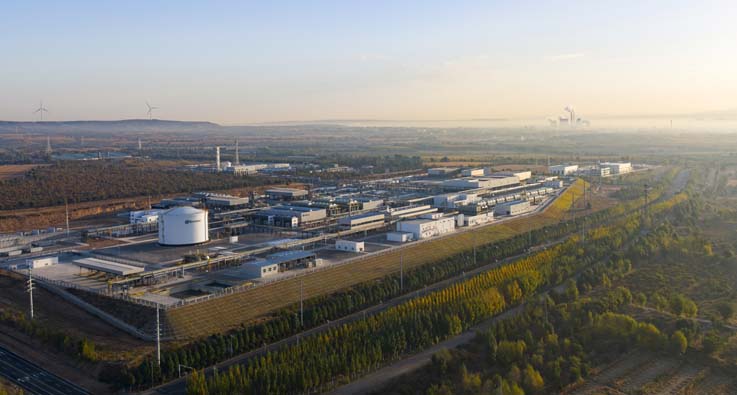
Envision Energy’s Net Zero Industrial Park in Chifeng, China
At the Chifeng facility, digital optimisation, including AI-driven forecasting to align production with variable wind and solar output, underpins the whole system. The priority is overall system efficiency rather than single-point performance, and it reduces reliance on grid balancing, an issue that continues to constrain hydrogen projects across multiple markets.
Deployment is now firmly underway. Hydrogen is being integrated into industrial processes at scale, particularly as a feedstock in chemicals and refining, and as a reducing agent in steelmaking. Derivatives such as green ammonia and methanol are entering shipping and aviation value chains. These are not pilots.
A defining feature of the most advanced projects is the emergence of integrated industrial clusters, where renewable generation, hydrogen production and end-use industries are co-located. This clustering effect addresses the persistent disconnect between supply and demand. It also enables infrastructure, off-take and production to scale in parallel, reducing project risk and accelerating commercialisation. Chifeng is a working example of this model, and Envision Energy is already replicating its approach across further sites.
The most significant shift in the sector may be the move from production to trade. Green ammonia exports are beginning to signal that hydrogen is becoming a globally traded commodity rather than a purely domestic decarbonisation tool. Envision Energy has demonstrated this end-to-end value chain at Chifeng, from renewable power and hydrogen production through to ammonia synthesis and international export.
Yu points to the first green ammonia shipment to South Korea as a proof point for the sector as a whole: “The first green ammonia shipment to South Korea was significant not just for Envision, but for the sector. It demonstrated that the barriers to cross-border hydrogen trade including storage, certification and transport are solvable. The infrastructure and the commercial frameworks are developing together, and that changes what is possible.”
The gap between plan and delivery in hydrogen has often come down to time. At Chifeng, Envision Energy has compressed what would traditionally be multiple sequential project stages into a continuous build-out: phase one is operational while expansion continues, and export capability was established within the same cycle as production rather than as a subsequent phase. This pace reflects long-term planning, manufacturing depth and an engineering culture geared towards scale.
The trajectory of the sector points to a structural shift: from pilot projects to industrialisation, trade and cost competition. For major economies with significant import ambitions, including those across Europe and Asia, the challenge is both scaling domestic production and finding a sustainable position in an increasingly interconnected global market.
This reinforces the importance of international collaboration on standards, certification and trade frameworks. As hydrogen markets develop, alignment across these areas will be critical to managing supply chain risk, ensuring interoperability and building the confidence that long-term off-take agreements require.
“The hydrogen sector is moving from a debate about potential to a focus on delivery,” adds Yu. “The projects that will define the market are the ones being built now, not the ones still in planning. Our focus at Envision is on execution and on creating a practical model for the industry.”
What is emerging is not a collection of national strategies running in parallel, but a single global market beginning to take shape, with its own pricing dynamics, trade flows and competitive pressures.
Envision Energy is a sponsor at this year’s World Hydrogen Summit and Exhibition. The event returns to Rotterdam, The Netherlands, from 19–21 May 2026, organised by RX Global in partnership with the Dutch Government, the Province of Zuid-Holland, the City of Rotterdam and the Port of Rotterdam.
To find out more and register to attend, click here.
KeyFacts Energy: Events l KeyFacts Energy: Hydrogen news
