 KEYFACT Energy
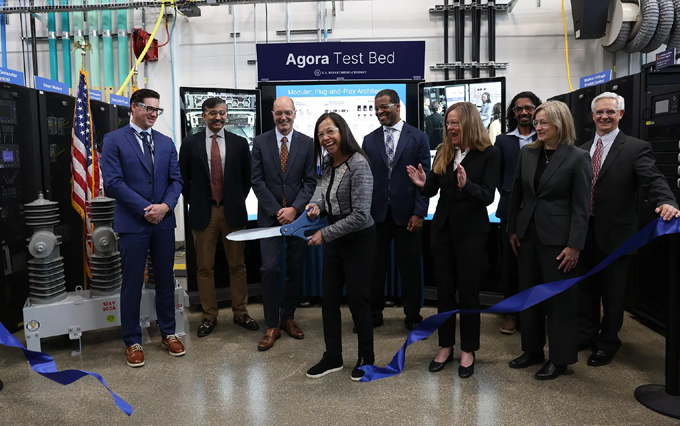
The Agora large-load test bed ribbon-cutting ceremony included DOE Office of Electricity Assistant Secretary Catherine (Katie) Jereza, industry partners, and NLR leadership. Photo by Joe DelNero, National Laboratory of the Rockies
New Capability Helps Data Centers Lower the Cost of Achieving a Reliable Grid
The U.S. Department of Energy’s National Laboratory of the Rockies (NLR) today unveiled the Agora large-load test bed, a first-of-its-kind national capability designed to help data centers become active participants in grid reliability.
Agora is funded by the U.S. Department of Energy’s Office of Electricity and industry partners and was designed in close collaboration with industry and utilities to address real-world challenges. It is the only dedicated large-load grid integration test bed across the U.S. national laboratory complex and replicates the technical complexity of a large-scale data center interconnection.
“We built a 20th-century grid—but today we serve a 21st‑century, data‑driven, AI‑enabled economy,” said Katie Jereza, Assistant Secretary of DOE’s Office of Electricity. “Through innovative test beds, we are not just experimenting, we are creating confidence in a powerful new capability—one that delivers affordable, reliable, and secure power that our homes, businesses, and overall economy need.”
Historically, most data centers have operated primarily as large electricity consumers, with limited opportunities or incentives to actively support the grid. Utilities also have limited insight into whether these facilities can temporarily reduce or shift operations to help maintain reliability. By adopting flexible designs and cost-saving operational practices, large loads like data centers can lower electricity rates for everyone. For example, when demand is at risk of exceeding supply, a data center could reduce its electricity use to prevent rolling blackouts.
Named “Agora” after the ancient Greek public gathering place for discussion and exchange, the test bed convenes utilities, data center developers, technology providers, and researchers across the country. Major industry partners, including Schneider Electric, Compass Datacenters, and Verrus, are already using Agora to achieve positive impacts for the grid.
“As data centers become one of the fastest-growing sources of electricity demand in the United States, utilities are being asked to manage large loads at a scale and speed the grid was not originally designed for,” said Jaquelin Cochran, Associate Laboratory Director of Strategic Energy Analysis and Decision Sciences at NLR. “The Agora test bed was built to answer one of the most important questions facing the power sector today: How do we advance U.S. leadership in AI and data centers while protecting ratepayers?”
By bringing together stakeholders in a “plug-and-play” environment, Agora is advancing informed and coordinated approaches to large-load grid integration.
“Very few facilities in the country can study both the grid and interactions with large loads under real-world conditions and at this level of detail,” said Martha Symko-Davies, Laboratory Program Manager for the Office of Electricity at NLR. “That integrated detail is essential as energy demand is growing exponentially and data centers need to establish themselves as good grid citizens—energy users that share responsibility for keeping the grid reliable.”
NLR will continue to partner with more utilities and data centers to adapt Agora’s capabilities and meet evolving industry needs.
The Agora test bed joins a suite of Office of Electricity-funded grid management and control assets at NLR and is part of the Advanced Research on Integrated Energy Systems (ARIES) platform—a visionary research platform sponsored by DOE’s Office of Critical Minerals and Energy Innovation that advances affordable, reliable, and secure energy systems.