 KEYFACT Energy
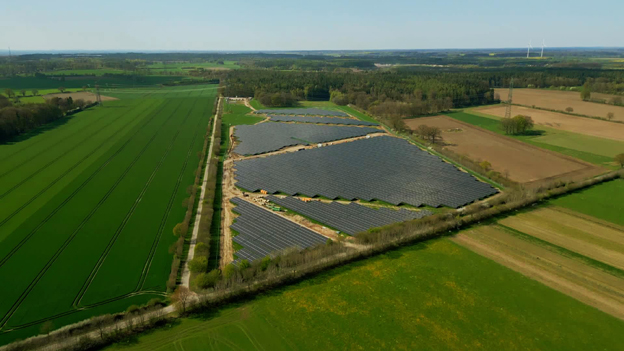
Vattenfall is breaking new ground in the construction of the large open-field solar park "Juliusburg / Krukow" in Schleswig-Holstein, using low-emission steel from its Swedish partner SSAB for the PV mounting systems for the first time. This reduces CO2 emissions in the construction and supply chain by 67 percent compared to conventional steel. It is the company's next step in supporting the decarbonization of industry and thus driving societal progress.
Solar power generation already makes a significant contribution to climate protection in Germany. However, the fact that the construction of solar parks also involves CO2 emissions has been largely overlooked . Vattenfall therefore aims to build solar and wind farms using materials that are produced with the lowest possible emissions. This will strengthen the demand for clean raw materials through concrete measures.
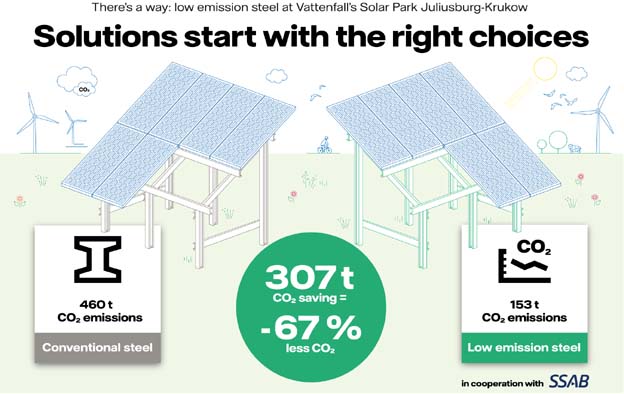
At the "Juliusburg/Krukow" solar park, Vattenfall is now using low-emission steel for the substructures of the solar modules for the first time on the Krukow section. The steel was produced from almost 100 percent scrap metal and has a reduced CO2 footprint by the Swedish steel manufacturer SSAB. Compared to conventional steel, SSAB Zero ™ emits 67 percent less CO2 . More than 9,000 profiles, weighing a total of 209 tons, support the solar modules and help to improve the solar park's CO2 balance right from the start.
Claus Wattendrup , Head of the Solar & Batteries business unit at Vattenfall, says:
“The electricity generated in this solar park will help reduce Germany’s dependence on imported fossil fuels. For us, however, independence from fossil fuels doesn’t end with electricity generation – it begins at the very start of the supply chain. That’s why we’re delighted to be taking this pioneering step together with our partner SSAB and to use low-emission steel for the substructures. By taking on a leading role as a company, we are supporting the long-term societal goal of becoming fossil-free.”
Matts Nilsson , Vice President and Sales Director at SSAB Europe, explains:
“This project demonstrates how combining clean energy generation, such as solar power, with low-emission materials reduces the environmental footprint across the entire value chain. With SSAB Zero™, we deliver decarbonized steel with the same performance and quality as conventional steel. Vattenfall’s decision to use it in this solar park is an important example of how ambitious customers can help scale emission reduction solutions and drive demand for cleaner materials.”
Vattenfall is also relying on low-emission steel in the construction of its wind farms. The company is using steel towers made of low-emission steel for the wind turbines at the Clashindarroch II onshore wind farm in Great Britain, as well as at the Nordlicht I and Nordlicht II offshore wind projects off the German North Sea coast near Borkum.
Leading markets need to develop
The recently published “Clean Industrial Transition Monitor” (Clean Industrial Transition Monitor: Moving to a clean industrial future in EuropeThe European Climate Neutrality Observatory (ECNO) concludes, among other things, that demand for clean raw materials, in particular, remains underdeveloped. This demand continues to rely on company announcements and voluntary initiatives. A key problem here is the lack of lead markets: "Lead markets for environmentally friendly materials and technologies are not yet developing sufficiently, exposing environmentally conscious manufacturers to high cost premiums and persistent investment uncertainty," the analysis states. The EU is attempting to address this problem. Targeted measures are intended to create a lead market for green steel. However, this requires that supply-side signals, such as the CO₂ price in the Emissions Trading System (ETS), remain strong and ambitious in order to reward companies that opt for investments in less CO₂ - intensive production processes.
Facts about the Juliusburg / Krukow project
- Nominal power: 80 megawatts (MWp)
- Expected annual electricity yield: 120 GWh (Equivalent to the electricity consumption of 30,000 average households )
- Site area: 74 hectares
- Reduction of CO2 emissions through the use of low-emission steel: -67 percent
KeyFacts Renewable Energy Directory: Vattenfall