 KEYFACT Energy

Project Overview
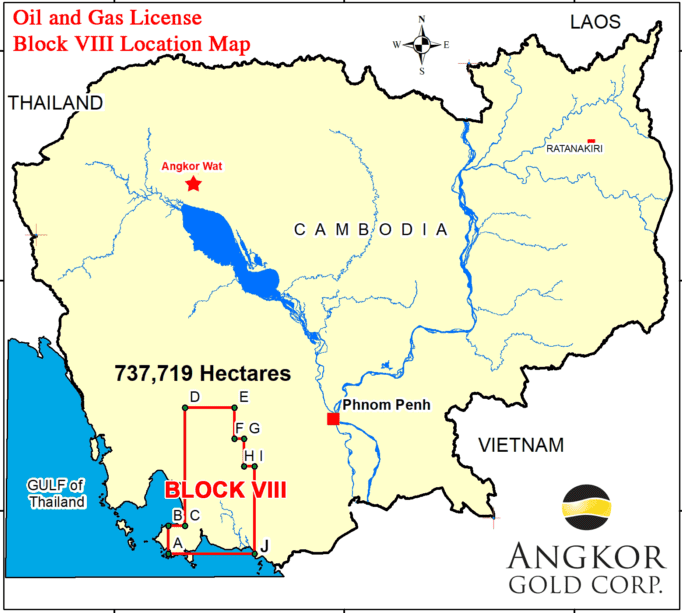
In August, 2019, Angkor announced that it had received approval of its license application for Block VIII, a 7,300 square kilometre oil and gas concession in Cambodia. Through COVID and by the end of 2022, EnerCam had completed the negotiation of the P.S.A covering a 30-year permitted area. Starting actual exploration in 2025, EnerCam first applied to have all parks and sensitive areas removed from the exploration zone. The company completed an Initial Environmental Impact Assessment by May of 2025, and then undertook 350 kilometres of 2‑D seismic.
Cambodia has traditionally been viewed primarily as country with a mining and mineral resource opportunities, with onshore exploratory oil and gas wells drilled in the entire country. However, sizeable oil and gas reserves have been developed on three sides of the country – in the Gulf of Thailand to the west, the Khorat Plateau of Thailand to the north, and in the Vietnamese Cuu Long Basin of the South China Sea to the south.
Cambodia's own oil and gas industry is not as well explored and developed as in surrounding countries, but activity is progressing rapidly. Angkor's energy subsidiary in Cambodia, EnerCam Resources Co. Ltd., has been leading the change to develop onshore hydrocarbon resources.
Farmin Opportunity
EnerCam’s 100% WI frontier PSC opportunity with new seismic, hydrocarbon indicators and partner funding sought.
- Angkor Resources Corp. is listed on the TSX Venture Exchange; EnerCam Resources, a wholly owned subco of ANK, holds Block VIII through a 100% working interest.
- EnerCam holds Cambodia's first onshore oil and gas 30-year, fully permitted PSC, covering 4,095 sq km in southwest Cambodia.
- Frontier onshore acreage with multiple direct hydrocarbon indicators and the first onshore wells to be drilled in Cambodia.
- 350km of 2D seismic acquired in 2025 has defined three Bokor anticlines and one Kirirom Basin stratigraphic play.
- EnerCam is seeking partners to acquire a material interest and fund a high-impact first drilling campaign.
Geology & Prospectivity
Prospect inventory: three Bokor anticlines and one Kirirom stratigraphic/updip pinch-out play.
- Prospect inventory comprises three Bokor Fold Belt anticlines each with four-way closure plus one Kirirom Basin stratigraphic/updip pinch-out play.
- North, Central and South Bokor are large doubly plunging anticlines with mapped closures of c.48-100 sq km each.
- Bokor targets have multiple reservoir objectives from Permian to Cretaceous intervals, with Triassic and Permian source potential.
- Kirirom is interpreted as a Cenozoic sag basin oil play with multiple fluvio-lacustrine reservoir targets, lacustrine source rocks and regional seals.
- More than two dozen documented oil seeps across Block VIII support an active petroleum system.
The thickness, burial history and reservoir and source rock characteristics of the Permian limestones in Cambodia appear to be as good or better than in Thailand, but no onshore wells have ever been drilled on the Cambodian side of the border.
Sedimentary basins are acknowledged to be the prerequisite for oil and gas discoveries. The sedimentary basins inland in Cambodia have never been systematically explored, partially because of previous historical regional instability and a poor understanding of local geology as it relates to hydrocarbons.
The Kampong-Som Basin is a newly recognized and completely unexplored onshore sedimentary basin in southwestern Cambodia. The Kampong-Som Basin was first identified and interpreted as a foreland basin in 2016 by researchers from the Danish Geological Survey who were interpreting a marine seismic database off the south coast of Vietnam. Khorat Plateau Basin, Tonle Sap Basin, and the Kampong-Som Basin are now interpreted to be one continuous foreland basin. The Kampong-Som Basin of western Cambodia extends from west side of Tonle Sap down to the Kampot area of the southern coast and is bounded by fold belts on East and West. Oil and gas pool geometry appears structurally-controlled by high-angle faults. The Kampong-Som Basin has a thermal maturity within the oil window and a higher thermal maturity within the dry gas window.
Cambodia's inland basin is covered by Mesozoic (Cretaceous, Jurassic) sandstones interbedded by conglomerates and clay stones. These structures are of Late Cretaceous-Cenozoic age and may have been developed at the same time as the basins in the Gulf of Thailand. The thick organic-rich shales of Cretaceous, Triassic or Permian Age are the probable source rock. The thickness, burial history and reservoir and source rock characteristics of the Kampong-Som Basin in Cambodia appear comparable to the Khorat Plateau Basin in Thailand, but no onshore wells have ever been drilled on the Cambodian side of the border. Until one or more high-risk exploratory test wells are drilled into this basin to assess the thermal maturity of these Permian limestones, it is impossible to determine if light oil or dry gas will be found, but comparisons have already been made by the — USEIA to the prolific Permian oil fields of Texas in the USA.
PSC & Licence Terms
30-year PSC terms, current Stage 1 status and staged exploration well commitments.
- 30-year Production Sharing Contract covering exploration through production, with extension potential once production is achieved.
- Licence in initial exploration period, started March 2025, and completed 2 years’ work plan in 10 months.
Stage 1: 3 years; geoscience, seismic and one exploration well commitment. EnerCam is currently in Stage 1 and is already drill ready on five drill targets.
Stage 2: 2 years; two exploration wells commitment.
Stage 3: 2 years plus extensions; one well per year commitment.
Accelerating through activities planned in 3 stages over 7 years, EnerCam is positioned to complete all three work stages, including drilling five wells, within 3 years.
- Commercial terms: include cost recovery, domestic market obligation and government option to purchase 25% of offtake at world price.
- EnerCam controls the offtake, so can choose to sell to refineries, power plants, topping plants, or any midstream operations. Government can buy 25% of the offtake at world price, if it chooses.
Analogues & Petroleum System
Petroleum system with Khorat gas and Fang oil analogues plus oil seeps and seismic-defined traps.
- Bokor structures are positioned as frontier extensions of proven regional Mesozoic petroleum systems.
- Khorat Plateau analogues in Thailand include Nam Phong (1.5 Tcf) and Phu Horm (1.4 Tcf) gas fields.
- Permian carbonates and Triassic-Mesozoic reservoir intervals provide proven regional plays.
- Kirirom Basin has oil-prone analogue support from NW Thailand's Fang Basin and other Cenozoic lacustrine basin plays.
- Surface oil seeps, mapped closure and seismic- supported trap definition provide multiple independent exploration indicators.
Prospect Scale & Resource Potential
Four mapped prospects as a >300 MMboe / >600 Bcf indicative unrisked resource opportunity.
- Four mapped opportunities provide a balanced portfolio of structural and stratigraphic plays.
- Relative prospect scale is driven by mapped areal closure from the source interpretation.
- Bokor delivers the largest gas-prone structural prize; Kirirom adds oil-prone basin upside.
- Given the early stage of exploration, the analogues, and the well-defined area extend of the anticlinal closures, any single Bokor prospect has the potential for several hundred million recoverable BOE discovery.
- Indicative resource scale illustrates pro-rata management’s targeted discovery >300 MMboe recoverable target, or gas equivalent exceeding 600 Bcf.
| Prospect/Lead | Play | Area km² | Indicative MMboe |
| North Boker | 4-way anticline | 100 | c.125 |
| South Boker | 4-way anticline | 57 | c.70 |
| Central Boker | 4-way anticline | 54 | c.70 |
| Kirirom | Strat/updip pinch-out | 28 | c.35 |
Preliminary unrisked exploration estimates based on areal closure only; not reserves. Volumes require well control, reservoir parameters and risking.
Work Programme
US$55M two-phase work programme earning 25% WI in Block VIII
- Team target exceeds 300 MMboe recoverable, or gas potential above 600 Bcf, with strong commercial gas potential.
- Phase 1: US$35 million for drilling, completion and production testing of five targeted exploration wells; earns 16% of Block VIII.
- Phase 1 is designed to confirm resource size, deliverability and commercial development pathway.
- Phase 2: US$20 million for development wells and advancement of oil and gas offtake options; earns a further 9% interest.
- Total funding package of US$55 million earns 25% of Block VIII, with partner moving into working interest participation for production, sales and future development.
Regional Context
Cambodia has traditionally been viewed primarily as country with a mining and mineral resource opportunities, with onshore exploratory oil and gas wells drilled in the entire country. However, sizeable oil and gas reserves have been developed on three sides of the country – in the Gulf of Thailand to the west, the Khorat Plateau of Thailand to the north, and in the Vietnamese Cuu Long Basin of the South China Sea to the south.
Cambodia's own oil and gas industry is not as well explored and developed as in surrounding countries, but activity is progressing rapidly. Angkor's energy subsidiary in Cambodia, EnerCam Resources Co. Ltd., has been leading the change to develop onshore hydrocarbon resources.
Contact Details
Ian Cross, Moyes, London
[email protected]
+44 7398 815 690
Maureen Macauley, Moyes, Houston
[email protected]
+1 713 851 4643
KeyFacts Energy: Angkor Resources Cambodia country profile l Industry Directory: Moyes & Co
