 KEYFACT Energy
EnergyPathways announces that, following the award of a Gas Storage Licence ("Licence") for its MESH project, the Licence work programme has been launched, and a site survey is planned for Q3 2026.
Formal acceptance of the North Sea Transition Authority's ("NSTA") Licence offer marks a significant milestone in advancing the MESH Project. The Company has commenced the Licence work programme and is planning an extensive survey in the East Irish Sea that will provide data to develop both the environmental, geological and seabed aspects of MESH. The survey results will underpin regulatory, engineering and subsurface workstreams as the Company progresses towards the next phase of development.
The Licence spans a substantial offshore area that could support the construction of up to 60 large-scale salt storage caverns, with the potential for multi terawatt-hour scale integrated energy storage, subject to the necessary consents and financing.
The planned MESH Project has been designated by the UK Government as a project of "national significance". It will comprise compressed air energy storage ("CAES"), natural gas storage transitioning to hydrogen storage and complementary hydrogen production for clean power and sustainable hydrogen industry uses.
Ofgem announces plans for Long Duration Energy Storage ("LDES") cap and floor second round
On 26 June 2026, Ofgem published its 'Minded to Decision' list of LDES projects under the first window of its cap and floor scheme. The announcement outlined Ofgem's intention to proceed with the LDES cap and floor second window, thereby confirming the Government's support for LDES investment infrastructure. Further direction will be provided by Ofgem by the end of 2026.
EnergyPathways welcomes the announcement by Ofgem, marking a significant milestone in the development of the UK's LDES market. With the Licence awarded, the Company is gearing up to enter its LDES CAES project into Ofgem's second window of the cap and floor scheme.
As the UK continues to increase its reliance on renewable electricity generation, LDES will play an increasingly important role in improving grid resilience, reducing renewable energy curtailment, and lowering overall system costs, which can lead to lower electricity prices.
Ben Clube, CEO of EnergyPathways, said:
"Ofgem's announcement marks another important milestone for the MESH project. It confirms the central role of LDES to the UK's future energy system. Establishing a robust investment framework is essential if the UK is to unlock the LDES infrastructure needed to support an electricity system capable of delivering affordable and reliable power.
"Ofgem's inclusion of CAES, albeit at small scale, in round one of the LDES technologies selected is notable in that it underlines the contribution that CAES technology can make alongside other LDES technologies in delivering a new flexible power supply.
"EnergyPathways continues to advance the LDES element of the MESH Project which will be the UK's largest LDES facility. Given its ability to supply multi-day duration power - as opposed to batteries which run out after a couple of hours - the Directors believe it is uniquely positioned to make a significant contribution to reducing the UK's heavy reliance on expensive gas power generation and lowering electricity prices."
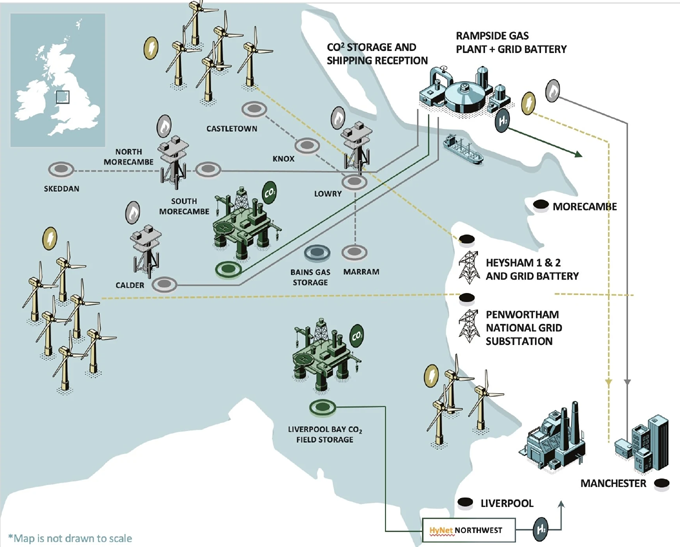
MESH Project
The UK Government is dedicated to doubling onshore wind and quadrupling offshore wind by 2030, as a central part of its plan to fully decarbonise electricity. In that time, UK wind capacity will increase from ~30 GW to ~90 GW.
With major constraints in the UK transmission grid and current wind capacity already at ~80% of peak winter demand, we fear that much of this taxpayer subsidised investment in wind expansion will be wasted. Wind curtailments already cost UK taxpayers ~£1bn p.a. and look set to rise steeply to ~£5+bn by 2030.
Gas, accounting for ~32% of the UK’s energy mix, will remain a critical transition fuel until green hydrogen storage can be deployed at scale to harness excess wind. Until then, gas is needed to fill the demand gaps arising from intermittent wind power and is vital for supplying heat to UK homes and industries.
The UK has some of the lowest levels of gas storage of the world’s major economies. With ~40% of UK energy supply already imported, and gas imports set to rise to 80% of gas demand by 2030, gas storage will be essential to secure reliable energy supply and reduce the impact of global prices on household bills.
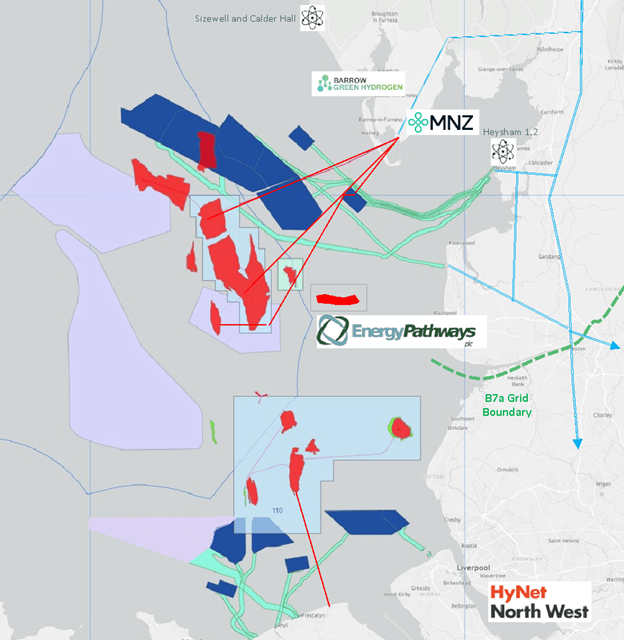
Ideal Location for Integrated Energy Storage
EnergyPathways is developing integrated energy storage that can provide the UK with secure flexible gas supply and leverage the growing value loss from the UK’s excess wind power by utilising green hydrogen storage solutions.
EnergyPathway’s MESH project (Marram Energy Storage Hub), located 11 miles from the Lancashire coast is an ideal location for energy storage development.
MESH is using high-quality geo-storage reservoirs within the region’s gas fields. These reservoirs have high injection and withdrawal rate attributes – ideal for flexible and reliable energy supply to back up intermittent wind, as well as meet volatile demand.
MESH is surrounded by 7-8GW of planned and existing offshore wind power that will be used to provide decarbonised energy to power the facility and store excess wind energy as green hydrogen.
Being close to existing late life gas pipelines, gas processing and offshore transmission lines, MESH can use these to readily connect new energy supply to the UK market, with the high population and industrial demand centres of North-West England nearby.
MESH is also well positioned to integrate with the nearby CCS sequestration reservoirs and the UK’s leading hydrogen hub - HyNet North-West - to bolster decarbonised energy supply for industrial clusters and peaking gas power.
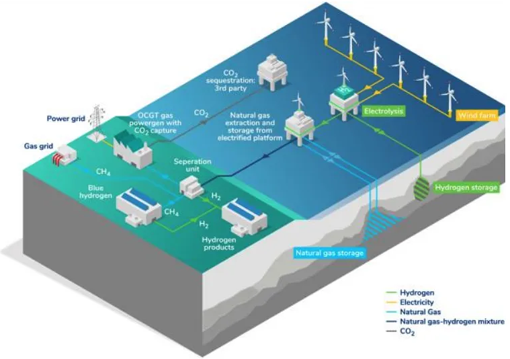
MESH - Major Gas & Green Hydrogen Storage Facility
MESH energy storage infrastructure will provide a secure and reliable supply of natural gas and green hydrogen for over 25 years. It is designed as an integrated zero GHG emission storage facility, fully electrified and powered by the region’s nearby renewable energy.
MESH’s storage capacity of ~14 TWh (~50 bn cubic feet of gas) will be of equivalent size to Centrica’s Rough facility, currently UK’s largest, and it will increase UK’s gas storage capacity by ~50%. It will be able to store an equivalent volume of energy to heat 2.5 million UK homes over winter.
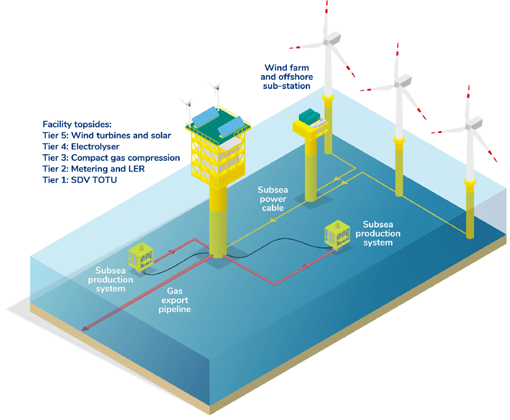
EnergyPathways’ development will use the UK’s oil and gas, and renewable work force and businesses. It comprises a gas storage project of 4 wells with pilot green hydrogen production that is positioned to harness the UK’s excess wind power with scaled up. Gas storage will be developed across two phases with initial formation gas production followed by full gas storage operations.
KeyFacts Energy: Energy Pathways UK country profile l KeyFacts Energy: Projects Database
