 KEYFACT Energy
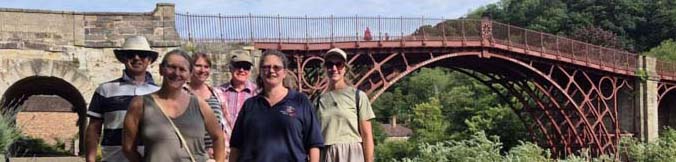
On 1 July 2026, Merlin marked a significant milestone—10 years as an employee-owned company. To celebrate in true geoscientist style, we swapped our desks for hard hats and headed to Shropshire for a couple of days exploring the region’s fascinating geology while taking in its stunning landscapes.
Led by Andy Sims, our first day took us to Much Wenlock and the impressive Wenlock Edge escarpment, where the contrasting geology creates one of Shropshire’s most distinctive landscapes. The ridge owes its dramatic form to the resistant Wenlock Limestone, which stands proud above the softer shales of the Coalbrookdale Formation. Our geological curiosity was sparked long before we arrived, with the tantalising en route views hinting at what was to come.
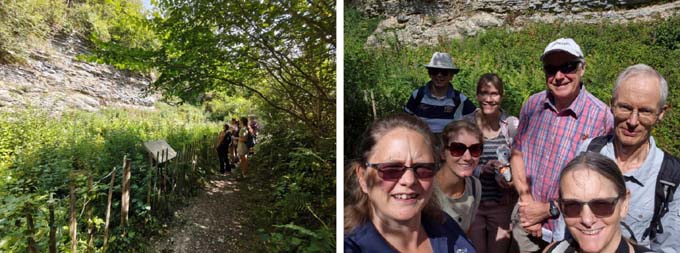

Knowle Quarry
Our first stop was Knowle Quarry, where we explored an outstanding exposure of the middle section of the Much Wenlock Limestone Formation. Here, beautifully preserved thinly bedded limestones were clearly draped over microbial ballstones. As with many geological exposures, the rocks raised as many questions as they answered. Standing in front of the outcrop sparked a lively discussion about the origin of the microbial ballstones and how they came to be preserved within the limestone sequence. Were they resting exactly where they had formed on the ancient sea floor, providing a snapshot of the depositional environment? Or had they become unstable and slumped downslope before being buried by later limestone sediments? Exploring these possibilities reminded us that geology is as much about interpreting evidence and debating competing theories as it is about observing rocks in the field.

Fossil finds at Stretton Westwood Nature Reserve, including microbial growths, corals and croniods
Continuing up through the stratigraphic succession, we made our way to Stretton Westwood Nature Reserve, a locality near the top of the Much Wenlock Limestone Formation. The site proved to be a fossil hunter’s delight, with corals, crinoids and brachiopods abundant throughout the exposure. As we examined the rocks and fossils, the debate resurfaced about whether these deposits were preserved in their original position or had been transported by slumping. Fortunately, the outcrop held an important clue. After a bit of scrambling, we came across an intriguing accumulation of coral debris containing specimens of Favosites sp., a coral with a well-defined growth direction. Observing these fossils revealed that some were orientated vertically while others lay horizontally. This mix of orientations provided compelling evidence that at least some of the material had been reworked and redeposited, helping to shed light on the complex history of these ancient sediments.
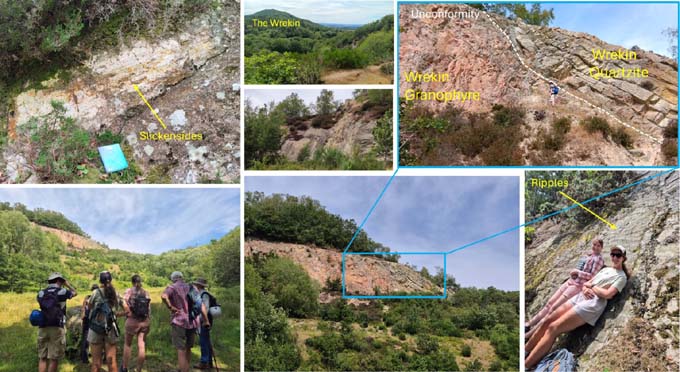
Ercall Quarry.
After a welcome lunch break we headed towards the Wrekin, travelling geologically back in time 140 Ma to the exposures of Ercall quarry. Here the unconformable contact between the Precambrian Wrekin Granophyre and Cambrian Wrekin Quartzite is clearly exposed. The Granphyre is a large intrusive body representing the final stages of the Uriconian volcanism in the area. It was unconformably overlain by sandstones (Wrekin Quartzite) of the Cambrian marine transgression.
We spent some time investigating the exact unconformable contact, and discussed the depositional nature of the beds within the Wrekin Quartzite.
The exposure comprises conglomeratic and sandstone-rich intervals, with conglomeratic material commonly occurring towards the base of the units and sandier material prevalent higher up. However, the relationship between these lithologies varied across the exposure. In some areas, a distinct bedding plane appeared to mark the top of the conglomerate, whereas elsewhere the sandstone seemed to be more closely associated with the underlying conglomerate, suggesting a fining upward sequence. This variability prompted discussion about how the beds were deposited and the processes responsible for their preservation. One of the exposed bedding planes of the quartzite contained excellently preserved 544 million years old ripple marks suggesting shallow water deposition. At another outcrop, structural geologists we were satisfied by being able to identify the direction of faulting from slickensides.
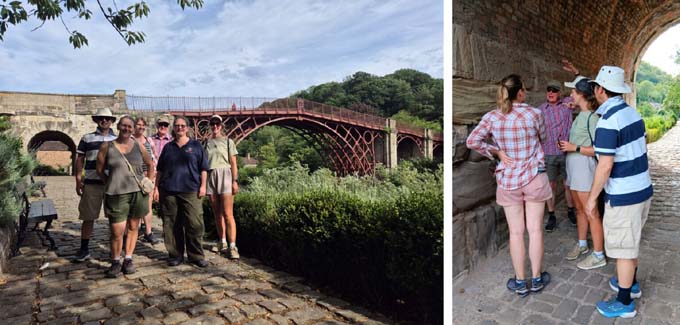
Ironbridge
After an excellent day in the field, we headed towards Ironbridge for the evening. No visit would be complete without a stroll to the famous Iron Bridge, the world’s first bridge made from cast iron, which was constructed in 1779 and cast by Abraham Darby III. It has been renovated and restored to its original red-brown colour, making it a very impressive view. Of course, we couldn’t walk past the excellent fluvial cross bedding examples on display in the sandstone blocks underneath the bridge! These blocks were sourced from the Little Flint Coal Measures of Carboniferous age in local quarries.

Stunning views from the top of the Wrekin
After a hearty breakfast the next day we headed back towards the Wrekin to complete the spectacular walk to the top of the Iron Age hillfort that is still visible at the crest of the hill today. The views were incredible, and we could even spot the Malvern Hills as we looked south.
Bridgnorth
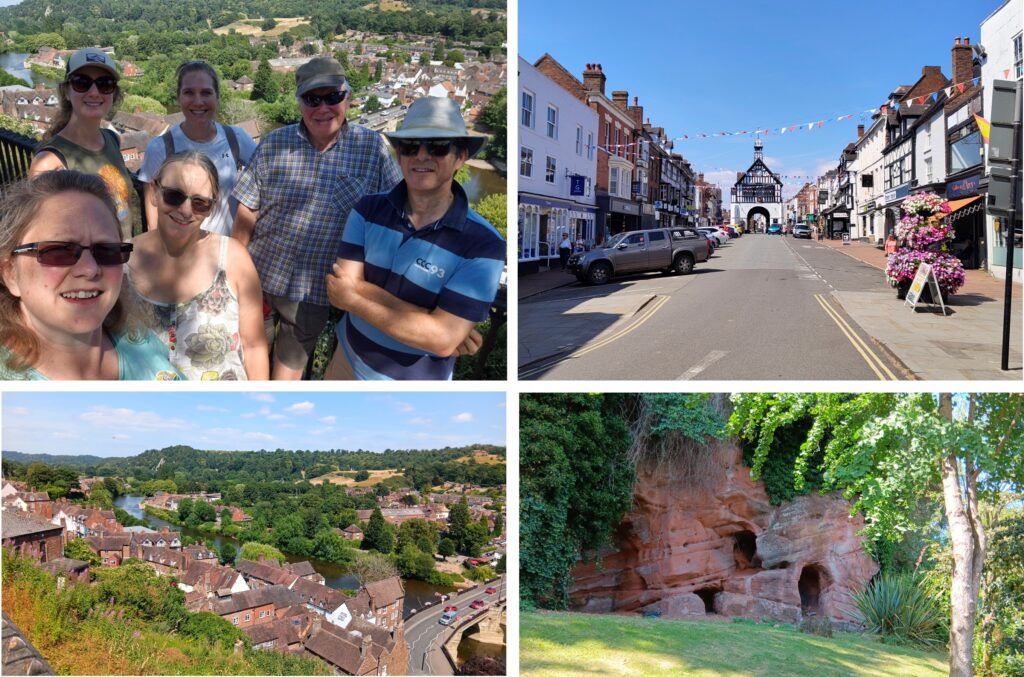
Our final stop of the tour was Bridgnorth, for lunch and a look around the pretty market town. We enjoyed the lovely views over the River Severn and in Low Town we saw the rock caves and tunnels dug into the soft aeolian red sandstone during the English Civil War.
Overall, the trip was a fantastic way to celebrate 10 years of employee ownership, combining world-class geology with the opportunity to learn more about the rich geological heritage of Shropshire. Just as importantly, it gave us the chance to spend time together away from the office, strengthening connections across the team while sharing our passion for the geosciences. The Employee Ownership Association’s theme for 2026 was #OwningIt, and we certainly embraced that spirit—doing what geoscientists enjoy most: getting out into the field, debating geological interpretations, waving our arms enthusiastically at rocks, and taking in spectacular scenery together.
KeyFacts Energy Industry Directory: Merlin Energy Resources